Blog Posts
El Mencho and the Crystal Meth Supply from Mexico: Anatomy of a Transnational Drug Network
Feb
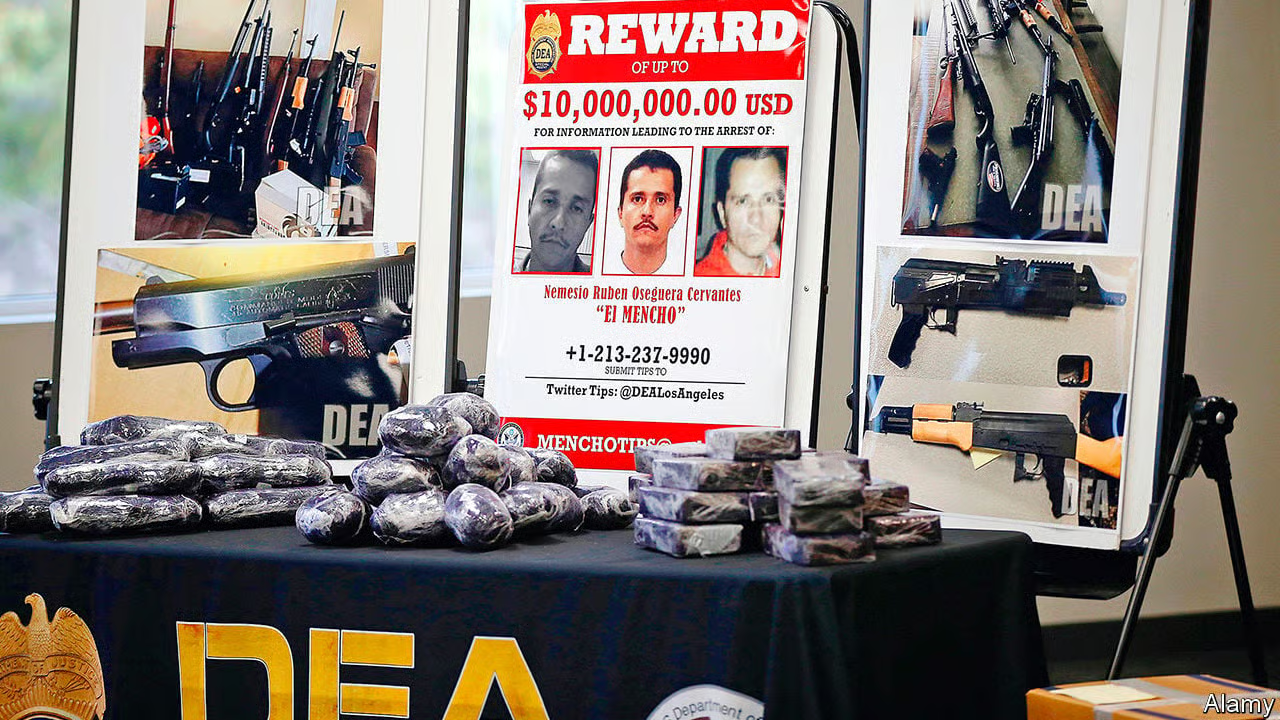
For decades, Mexico has been a flashpoint in the global war on drugs — not only as a transit route for cocaine and heroin but increasingly as a production hub for synthetic drugs such as crystal methamphetamine and fentanyl. At the center of this transformation stood Nemesio Oseguera Cervantes, alias “El Mencho”, the infamous head of the Cártel Jalisco Nueva Generación (CJNG). Understanding his rise, the industrialization of drug production under his leadership, and the broader implications for the supply of crystal meth requires unpacking the evolution of cartel dynamics in Mexico and their exportation of synthetic narcotics, particularly to the United States.
Who Was El Mencho? The Emergence of a Drug Kingpin
Originally from Aguililla, Michoacán, El Mencho became one of the most powerful figures in Mexico’s criminal underworld over the past two decades. He founded the CJNG in the early 2010s, building upon earlier affiliations with the Cártel del Milenio and quickly rising to prominence as rival organizations waned. Under his leadership, the CJNG expanded rapidly, boasting a presence across much of Mexican territory and into international markets. In 2026, El Mencho was reported killed in a major security operation in Jalisco, a development that heralds a turbulent period for the cartel and the broader narcotics landscape in Mexico.
Crystal meth supply from Mexico
In contrast to the old model of narcotics trafficking — heavily reliant on plant-based drugs like marijuana and opium poppy — the CJNG under El Mencho embraced a more industrialized approach to synthetic drugs. From the mid-2000s onward, the cartel identified methamphetamine and later fentanyl as high-profit products with growing demand, especially in the United States.
By exploiting remote mountainous regions of Jalisco, Michoacán, and surrounding states, the CJNG established networks of hidden meth labs equipped with industrial-scale reactors and chemical supplies. These facilities were strategically located near transportation routes and seaports, facilitating the movement of finished products across borders. Meticulous planning also went into controlling the supply chain of precursor chemicals, often imported through legal and illegal channels to sustain continuous production.
Crystal Meth and CJNG’s Distribution Network
Crystal methamphetamine — a potent and highly addictive form of meth — became one of the cartel’s flagship products. Unlike fentanil, which grew in prominence later, meth’s dominance in CJNG’s portfolio was rooted in its economic appeal and high demand among drug users in North America. The cartel not only produced crystal meth but also developed efficient transport and distribution systems. These systems leveraged both traditional smuggling routes and newer, more sophisticated methods involving compartmentalized transport to evade law enforcement detection.
According to various security sources, CJNG operatives transported massive quantities of meth across Mexico toward the U.S. border, where they could fetch high market rates. Some reports even detail early coordination between CJNG and other cartel factions — such as alliances with the Cártel de Sinaloa — to move meth through corridors like Ciudad Juárez and El Paso, Texas.
The Industrialization of Meth Production – Crystal meth supply
Under El Mencho’s leadership, the CJNG did not merely produce meth; it refined and scaled production. Unlike smaller cell structures that relied on makeshift labs, the cartel invested in larger, sophisticated sites capable of producing standardized batches of crystal meth at scale. This replicated a quasi-industrial process where consistency in purity and output volume became priorities, enhancing the cartel’s competitiveness against other drug producers.
Reports from law enforcement operations indicate that these labs were fitted with ventilation systems, chemical storage areas, and security perimeters, effectively mirroring an illicit manufacturing plant rather than a simple backyard lab. These efforts helped them dominate meth supply in multiple regions, particularly in the southwestern and central United States.
Violence, Territory, and Control Over Meth Markets
CJNG’s grip on meth was not only a question of production and logistics but also one of territorial control. The cartel engaged in ruthless campaigns to eliminate competition, secure distribution hubs, and enforce sales dominance. For instance, in 2024 a series of narcomantas — physically hung banners with messages from the cartel — warned against the sale of crystal meth not controlled by the CJNG in Aguascalientes, asserting their authority over local drug markets.
This exercise of power often translated into extreme violence, with assassinations, kidnappings, and confrontations against rival groups marking CJNG’s expansion story. The willingness to use force to secure both territory and market share underscores the high stakes of the meth trade in Mexico and beyond.
Law Enforcement Response and the Future of Meth Supply
The unprecedented scale at which the CJNG and similar organizations operated has drawn intense scrutiny and action from U.S. and Mexican law enforcement agencies alike. Joint operations have resulted in large drug seizures, arrests of key figures, and efforts to dismantle supply networks. In recent years, federal agencies seized tons of methamphetamine alongside other illicit substances in coordinated interdiction operations, a testament to the massive flow of these drugs across borders.
However, the death of El Mencho presents a new chapter. While it marks a symbolic blow to CJNG’s centralized leadership, experts warn that the momentum of drug production and trafficking may not end with his demise. Entrenched networks, local cells, and diversified sources of chemical precursors mean that meth supply routes could continue operating, albeit perhaps splintered or under new leadership.
Conclusion
El Mencho’s legacy is inseparable from the rise of crystal methamphetamine as a cornerstone of Mexico’s synthetic drug economy. Under his direction, the CJNG transformed from a regional gang into a transnational powerhouse capable of industrial‐scale meth production and distribution. Although recent developments, including his death in 2026, signal a fracture in that structure, the challenge of controlling the flow of crystal meth remains. As authorities on both sides of the border adapt to changing tactics and technologies, the story of meth trafficking from Mexico continues to evolve — a stark reminder of the enduring complexity of the global drug trade. visit https://crystalmeths.com/